Latvian court decision revives hopes for Belarusian-language public broadcasting on LSM+
 9 April 2026
According to Radzivon Biahliak, chairman of the Association of Belarusians in Latvia Supolka, the main achievement of advocacy efforts so far is that Belarusian journalists have remained at LSM+. The Belarusian section’s archive has also been preserved. Additionally, stories covering life and events in the diaspora are regularly published.
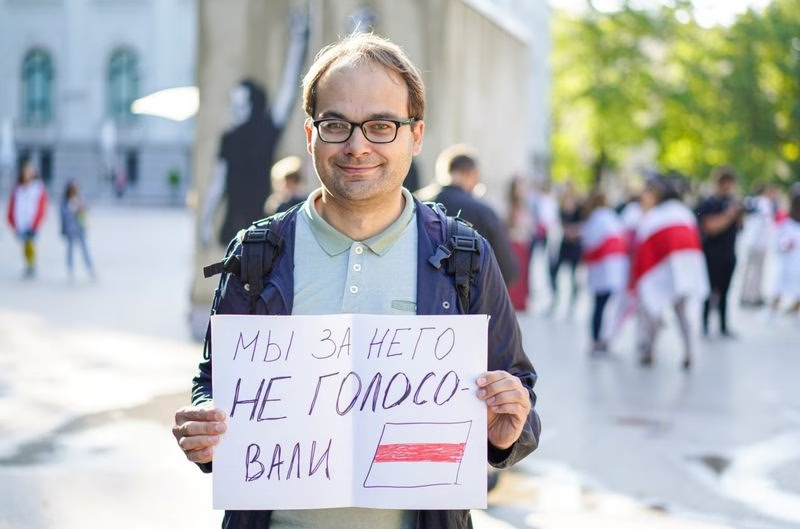
Radzivon Biahliak at a Belarusian protest action in Riga. Photo: Supolka
The board of the Latvian public news outlet LSM developed strategic priorities for 2026–2029 in the summer of 2025. According to the document, content in foreign languages, such as English, Russian, and Ukrainian, should only be created and distributed in a digital environment. The Belarusian-language version of the website was only available until the end of 2025.
Radzivon Biahliak, chairman of the Association of Belarusians in Latvia Supolka, discussed the situation that has developed this year, the losses suffered by the Belarusian and Latvian media landscapes as a whole, and the prospects for resuming Belarusian-language work at LSM.
Current cooperation
In the fall, LSM board chair Baiba Zuzena, in response to BAJ, promised to “continue cooperation with Belarusian journalists and the national diaspora.” Is this cooperation happening in practice?
Yes, the journalists have remained employed. And this can be considered the main result of our advocacy, because, for example, the Polish section completely left the portal. The Belarusian section’s archive has also been preserved via a direct link — Bel.LSM.lv.
Since the beginning of the year, materials have regularly appeared covering both diaspora life and related events — for example, the recent concert by Lavon Volski and the fifth anniversary of the Association of Belarusians in Latvia Supolka. There is also an op-ed about Belarus.
Obvious losses
And yet, is the closure of the specifically Belarusian section of LSM+ noticeable for the Belarusian diaspora?
Absolutely. Latvia has great respect for its language, and the presence of Belarusian on the state news outlet was a means of our distinct identification and separation from the Russian diaspora.
I’ll list the negative points. First, due to editorial changes, the Belarusian-speaking audience was forced to switch to Russian.
Second, when a separate Belarusian section existed, thanks to the efforts of former editor Aliaksandr Krasnitski, our journalists’ articles were additionally translated into Russian and Latvian. Now they are published almost exclusively in Russian, leading to a significant reduction in the overall audience.
The numbers speak for themselves: the Latvian-speaking audience (LSM.lv) accounts for 70–75% of users (400–550 thousand), while the Russian-speaking audience accounts for just 20–22% (120–160 thousand). The lack of Latvian translations effectively isolates regular Belarusian topics from the majority of society.
Information security hasn’t improved
Back in fall 2025, concerns were expressed that the closure could affect Latvia’s own information security. How do you assess this risk now?
This is a very relevant question for Latvia. Despite the Belarusian regime’s complicity in aggression, a 2025 poll showed 33% of Latvia’s residents view Aliaksandr Lukashenka positively. 30% have a clearly negative position, while 37% abstained, which can be interpreted as a hidden opinion, since supporting a dictator is not mainstream in the country.
We can see evidence of Belarusian propaganda on social media. For example, the “Moving to Belarus for Permanent Residence” group has 19,000 members, and “Belarusians of Latvia” has 25,000. According to Belstat, Latvian citizens are the second largest group of tourists to visit Belarus, behind only Russians.
People are not deterred even by the savage prison sentences received by Dzmitry Mikhailau and Ala Sakalenka on fabricated charges. The Latvian Foreign Ministry’s constant “direct” warnings don’t work. It is precisely Belarusian journalists who, through their experience, could convey the real situation and show the workings of the repressive machine from the inside.
The recent news about Belarusian propaganda being broadcast on the frequencies of the defunct Russian-language radio station LR4 — where Radio Belarus began broadcasting instead of Kultura Radio, increasing the signal power by fourfold — once again highlights the importance of information security.
Restoring the Belarusian language to the media landscape
How does Supolka assess the current situation with Belarusian presence in Latvia’s media landscape? Are there any plans or projects?
We have received support at the highest level — from the Cabinet for National Revival under Sviatlana Tsikhanouskaya’s Office, as well as from the European Federation of Journalists and the Belarusian Association of Journalists. Many thanks to Latvian politicians who understand the need for broadcasting in national minority languages.
Last week, the Constitutional Court issued a decision calling on legislators to review existing regulations.
The document states: “The scope of the state’s obligations with respect to ensuring the rights of national minorities depends on the actual situation of a particular national minority in the state, e.g., the number of persons belonging to it, the spread of the language, the accessibility of media, the wish and ability to independently ensure access to information in its language, as well as other circumstances.
Furthermore, in fulfilling the state’s obligation to facilitate the access of such national minorities to public media it must be assessed whether the respective national minorities have access to mass media in their own language.”
The Saeima Legal Bureau also spoke in support of minority languages, noting that public media content in these languages serves as an alternative to the Russian media landscape, which contains propaganda and disinformation.
This gives us a chance to restore the Belarusian language to the news portal. We already raised this issue during Sviatlana Tsikhanouskaya’s visit to Riga before she met with President Edgars Rinkēvičs and deputies of the democratic Belarus support group.
Belarusians are the third-largest national minority in Latvia, traditionally living in the southern regions. And while the Constitutional Court now recognizes Russian in Latvia as “self-sufficient,” Belarusian is under threat of disappearing, gradually being replaced by Russian. It has also come under severe repression in Belarus itself.
We need to continue our work by telling the truth about the real state of the Belarusian language and culture in our country. This would be supported by organizing the exhibition Belarus: Voices of Banned Books and by continuing discussions with lawmakers on ways to support and preserve the Belarusian language in Latvia’s information and cultural space.


 @bajmedia