E‑newsletter: MASS MEDIA IN BELARUS No.3 (84) 2026
 4 September 2026
Mass media in Belarus in April – June 2026. Review. Download PDF.
Repressions against independent media representatives and severe restrictions on access to information continued in Belarus in April-June 2026.
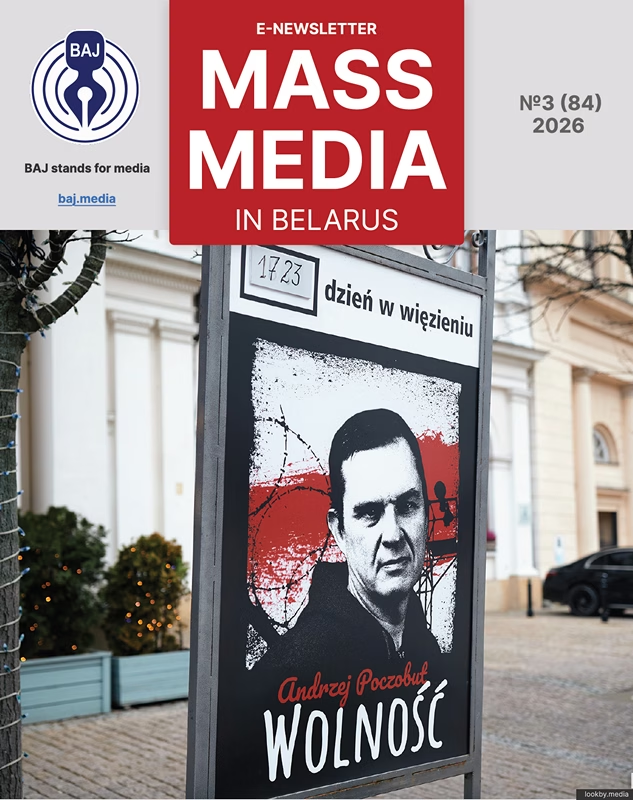
The release of journalist Andrzej Paczobut after 5 years behind bars was a positive development within the period under review. The media worker was released from prison on April 28, 2026.
At the same time, 21 media workers remained in prison in Belarus, and courts continued to pronounce new sentences in criminal cases against journalists. Transnational persecution of Belarusian exiled journalists expanded in various forms, including criminal prosecution in absentia, pressure on relatives, cancellation of Belarusian passports, deprivation of property in Belarus, and harassment in propaganda media. Among other, the persecution trend was targeted at the journalists, who had been released due to agreements with the US envoy’s missions in Belarus.
As before, a broad wave of censorship was based on anti-extremism legislation. However, the authorities did not limit themselves to blocking access to independent media from Belarus in April – June 2026. They also resorted to regular DDoS attacks. As a result of these attacks, the websites of six online news publications, as well as the website of the Belarusian Association of Journalists were temporarily unavailable to readers. The social media Threads and TikTok started gaining popularity with the Belarusian audience since recently. Consequently, both social media attracted the unwanted attention of Belarusian authorities.
The state media continued their aggressive propagandist activity under the period under review. However, they faced certain complications at the international level. Thus, the YouTube video hosting service removed the channels of three state media outlets and the Belarusian Telegraph Agency from their platform.
Criminal prosecution. Cases of detention in Belarus
Repressions against independent journalists continued in Belarus. They included criminal prosecution and other various forms of pressure.
Minsk City Court pronounced verdicts to journalist Kiryl Pazniak and his daughter Yanina Pazniak on June 26, 2026.
Kiryl Pazniak was sentenced to three and a half years in prison. The sentence of Yanina is still unknown.
Both of them were accused of ‘creating an extremist group’ and ‘discrediting the Republic of Belarus’ (Articles 361–1 and 369–1 of the Criminal Code of Belarus).
It is worth mentioning that Kiryl Pazniak created the ‘Platform 375’ YouTube channel, which was labeled as an ‘extremist group’ by the Belarusian authorities in September 2025. According to the Belarusian justice, Yanina’s entire ‘fault’ lies in the fact that she started this channel on TikTok.
Reportedly, a journalist Aliaksandr (Ales) Liubianchuk was convicted again within the period under review. He was initially convicted in 2022 and released from custody in January 2025, having served his entire prison term.
The media worker was put on trial in a new criminal case in March 2026. The journalist was accused of ‘facilitating extremist activities’ (Article 361–4 of the Criminal Code of Belarus) as well as ‘inciting hostility’ (Article 130 of the Criminal Code of Belarus) for negative comments about the authorities this time.
The court sentenced Ales Liubianchuk to 4 years of imprisonment in a maximum-security prison. However, taking into account the previous sentence served by the journalist (as per Part 5 of Article 72 of the Criminal Code of Belarus – ‘Assignment of punishment basing on the aggregate of crimes’) and the time spent by the media worker behind bars in a pre-trial detention center, he was released from custody on May 12, 2026.
A photographer Aliaksandr Shyshko was detained at Minsk National Airport in April 2026. He had been living in the forced exile for a couple of years.
A criminal case was filed against the journalist in connection with his participation in the celebration of Freedom Day abroad in 2023. Consequently, his apartment was searched.
It is known that the media worker is charged under Article 361–3 of the Criminal Code of Belarus (‘participation in an armed conflict on the territory of a foreign state’) this time.
Transnational persecution
The Belarusian authorities continued to put pressure on the relatives of journalists working in exile within the period under review.
In particular, the editorial office of ‘Flagshtok’ media outlet (Homiel) that covers regional events and monitors military activity on the Belarusian — Ukrainian border reported that security forces searched the homes of the parents of two people associated with the publication on May 19, 2026. They were told that ‘such actions will be continued as soon as new publications are published on the Web-resource.’
Reportedly, the families of journalists from the Belarusian editorial office of Deutsche Welle faced pressure, too. Quite a few of them were visited by representatives of various law enforcement agencies within the period under review.
On April 2, 2026, a propaganda program broadcast on the ‘Stalichnaye Telebachannie’ (‘Capital TV’, CTB) channel reported on the criminal prosecution in absentia of the head of the Belarusian Investigative Center Stanislau Ivashkevich and sixteen other representatives of this media outlet.
At the same time, the employees of another Belarusian investigative media project, Buro Media, were named as defendants under Articles 361 (‘calls for sanctions’) and 361–1 (‘creation of an extremist group or participation in it’) of the Belarus Criminal Code: Aliaksandr Yarashevich, Volha Ratmirava (Alkhimienka), Kseniya Viaznikoutsava and Aliaksei Karpeka. The alleged ‘accomplices’ included Russian citizens – journalists Aliaksandr Vastrou, Katsiaryna Mitrokhina, Maryna Dulneva and a Ukrainian citizen Maksim Sauchuk. A threat of criminal prosecution was also announced against anyone who provided updates to the BIC chatbot.
The tacit cancellation of passports of Belarusian citizens who were released from jail and deported from Belarus due to the US diplomatic efforts has become another form of transnational persecution. A journalist Ihar Karnei faced this situation in the period under review.
Uladzimir Khilmanovich from Hrodna became the first journalist to be deprived of real estate in Belarus. The authorities auctioned off his apartment and summer house in June 2026. The media worker was sentenced in absentia for the alleged manifestation of ‘extremism’ to 5 years in prison and a large fine.
Censorship
The so-called ‘extremist’ crimes remained the main formal basis for the persecution of independent media sector representatives and censorship restrictions.
Five independent media projects – ‘Novy Chas’, Belarusian Investigative Centre, ‘The Clock is Ticking’ YouTube Channel, Reform.news as well as Proinfo.news Web-portal were included in the list of ‘extremist groupings’ by the Ministry of Internal Affairs within the period under review. The latter Web-resource is listed on the Ministry’s Website as ‘Belarusian Association of Journalists,’ although it is not related to the organization.
Five imprisoned media workers were included in the list of individuals, who are allegedly ‘involved in extremist activities’: journalist Tsina Palynskaya and her daughter Marharyta Rabinovich, radio host and musician Aleh Khamenka, director of ‘Intex-Press’ Uladzimir Yanukevich and his deputy Andrei Pakalenka.
The twice-convicted journalist Aliaksandr (Ales) Liubianchuk was labeled as a ‘person related to the terrorist activity’ by the Belarusian authorities within the period under review.
A huge list of the allegedly ‘extremist materials’ on the Website of the Ministry of Information was further supplemented with new publications of Belarusian and foreign independent media in April – June 2026. The public access to these materials is supposed to be blocked by the Belarusian law-enforcement agencies. Also, their distribution is subject to administrative liability in Belarus.
In particular, the Voice of America Website and the Russian Mediazone online publication were added to the ‘National List of Extremist Materials’ within the period under review. Also, the Threads account of the Belarusian Association of Journalists — baj.media.by was recognized by the Belarusian authorities as ‘extremist media production’ on May 27, 2026.
There were registered cases of repeated inclusion of the same media resources in this list. Thus, the First Region website was included in it for the fourth time. (Its content was initially labeled as ‘extremist’ by the Belarusian authorities at the end of 2021.)
The ‘Roskomnadzor’ Russian controlling authority blocked public access to the BAJ Web-site from the territory of Russia on May 7, 2026.
Most probably, the authority was concerned with the high popularity of BAJ Web-publications on the methods of bypassing censorship and blocking of online resources with the Russian audience.
Six Belarusian exiled media – ‘Zerkalo’, Reform.news, Nasha Niva, Pozirk, Mediazone. Belarus, European Radio for Belarus as well as the Belarusian Association of Journalists were targeted by regular DDoS-attacks within the period under review. These cyber-attacks overload Websites with a huge number of Internet requests and make them inaccessible to real Web-visitors.
The social media Threads and TikTok started gaining popularity with the Belarusian audience since recently. Consequently, both social media attracted the unwanted attention of Belarusian authorities.
Thus, a well-known propagandist Ihar Tur called the social media Threads ‘knowingly hostile’ during a ‘Hrodna Plus’ broadcast. Also, he noted that the authorities regard it as a potential threat of a platform for getting Belarusians ready for the social unrest. At the same time, the propagandist admitted that he uses provocative communication methods and conducts secret activities on the Web with the use of fake accounts.
The Investigative Committee issued a public statement in June 2026. Among other, it was noted that “in light of the increasing number of cases of dissemination of destructive information, legal investigators are increasing monitoring and responding promptly to publications and comments, especially in Threads and TikTok, with subsequent legal assessment of the authors’ actions.” It was underscored that at the very least, special attention will be paid to the publications, containing ‘disinformation of the population, incitement of social hostility, knowingly false reports of danger, and rehabilitation of Nazism.’
Propaganda in the state media
The propaganda activities of the state media continued in the same direction within the period under review. However, they faced certain obstacles at the international level.
The ‘Soyuzny’ new propaganda TV channel was founded in Belarus on April 1, 2026. It emerged due to the reforms of the so-called Union Media of Belarus and Russia. It is part of the ‘Media Company of the Union State.’ The ‘Soyuzny’ replaced the ‘BelRos’ propaganda TV channel that had been broadcasting its programs for almost twenty years.
The Belarusian state media reported on the evening of April 3, 2026, that the YouTube video hosting service had removed some of their channels from the platform. The list of affected media included the Belarusian Telegraph Agency (BelTA), the ‘Stalichnaye Telebachannie’ (‘Capital TV’, CTB) channel, and ‘All-National’ TV (ANT). CTB launched a new YouTube channel a few days later. However, it was also removed from the video hosting service afterwards.
The outraged pro-government media outlets responded with threats to have the YouTube video platform labeled as ‘extremist’ and completely block it for public access from the territory of Belarus. The Ministry of Information of Belarus stated that it regarded these blockings as ‘an unfriendly and groundless step and reserved the right to take the necessary measures in response.”
Dzmitry Zhuk was appointed as a new Minister of Information of Belarus on April 9, 2026. He spoke cautiously when asked whether YouTube would be blocked in Belarus. ‘We need to look for other mechanisms for relations with these major players in the global media space,’ he said. However, he named the blocking of the BelTA, CTB, and ANT YouTube channels ‘an information war without rules.’
On May 14, 2026, it was reported that that YouTube had blocked another Belarusian propaganda channel. The state-owned ‘Radio Belarus’ media outlet was removed from the video hosting service this time. It broadcasts programs for a foreign audience.


 @bajmedia
European Journalists’ Soccer Tournament Opens With Minute of Silence for Mikita Melkaziorau
14.09.2026
Special proceedings “for rehabilitation of nazism” launched against TV host Katsiaryna Vadanosava
14.10.2026
Five journalists among those released on September 16
16.09.2026
BAJ stands in solidarity with Ukrainian colleagues
02.10.2026