Belarus: Imprisonment and exile of journalists continues six years on from the fraudulent presidential election
 7 August 2026
Six years on from the fraudulent Belarusian elections of 9 August 2020, the crackdown on press freedom in Belarus has intensified, with 21 journalists currently imprisoned and those in exile facing intimidation. The International and European Federations of Journalists (IFJ-EFJ) joins their affiliate, the Belarusian Association of Journalists (BAJ), in calling for an end to the criminalisation of journalists, and for the immediate and unconditional release of all those imprisoned for doing their job.
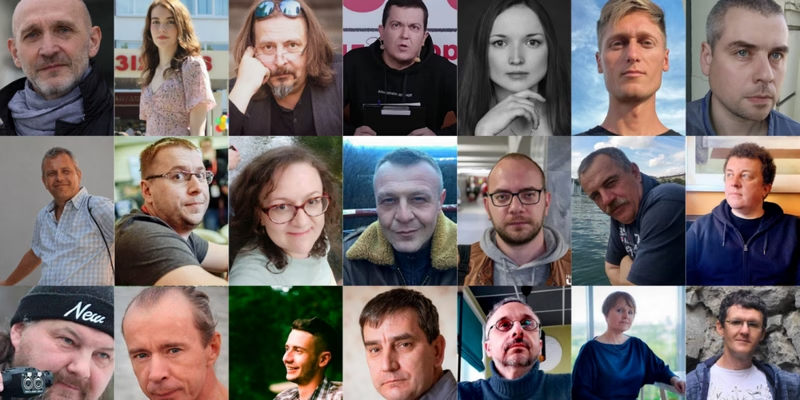
Twenty-one journalists and media workers currently behind bars for political reasons in Belarus. Credit: BAJ
Since the fraudulent Belarusian elections on 9 August 2020, President Aleksandr Lukashenko’s regime has increased pressure on dissidents and intensified its crackdown on the press, handing out disproportionate prison sentences to journalists in Belarus and intimidating and harassing those who have been forced to exile. The crackdown has also affected the BAJ, which was labelled ‘extremist’ in 2023. It is the only independent and democratic association of Belarusian media representatives.
According to the BAJ, as of August 2026, 21 journalists and media workers are behind bars for political reasons. Among them are individuals with serious illnesses or advanced age, such as journalist Kiryl Pazniak, who was hospitalised in May due to pneumonia and a concurrent case of Covid-19 while in pre-trial detention.
This year alone, six journalists were convicted and sentenced within a week. Uladzimir Yanukevich and Andrei Pakalenka, former heads of independent regional newspaper Intex-Press, were sentenced to 14 and 12 years in prison respectively for alleged “high treason”; Journalist Pavel Dabravolski was sentenced to nine years for a similar offence; radio host Aleh Khamenka was sentenced to three years for “collaborating with the media”; and journalist Tsina Palynskaya was sentenced to two years for alleged collaboration with an extremist entity, alongside her daughter.
Moreover, the persecutions do not stop at the border, and journalists in exile continue to be intimidated. In recent years, Belarus has actively persecuted independent journalists who have been forced to flee the country. BAJ reports that criminal cases have been opened against them, their families have been searched, their property has been confiscated, and they have been placed on international wanted lists.
As a result of political pressure, exiled Belarusian journalists whose passports have expired are unable to renew them and thus encounter difficulties in their host countries, particularly the EU, Ukraine and Georgia. This internal political pressure manifesting as an external bureaucratic obstacle constitutes a violation of journalists’ rights to practise their profession freely.
“Despite all this, the Belarusian independent media sector remains highly effective and effectively influences events in the country. Independent media have a huge domestic audience, receive reader feedback, and are significantly more effective than state-run media.” said the BAJ in a statement to the IFJ. “We believe that our primary goal is to maintain the independent media sector’s effectiveness and competitiveness. The BAJ continues its journalist assistance and educational programs, provides legal assistance, and supports the independent media community.”
The IFJ-EFJ said: “Not only does Lukashenko’s regime prevent journalists from doing their job and violate the public’s right to information by intimidating, prosecuting and imprisoning them, it also infringes the most basic civil rights of imprisoned journalists and media workers in exile. We reaffirm our unwavering commitment to BAJ and Belarusian journalists, and we demand an end to their criminalisation and harassment. We also urge the immediate and unconditional release of all imprisoned journalists and media workers.”


 @bajmedia
Five years of lawlessness: How Belarus’s media was silenced — and fought back
12.08.2025
Belsat documentary filmmaker flees Belarus after searches
27.07.2026
European Journalists’ Soccer Tournament Opens With Minute of Silence for Mikita Melkaziorau
14.09.2026
“Bazhynki” reborn: Media Camp near Vilnius brings journalists together in an act of solidarity
26.08.2026